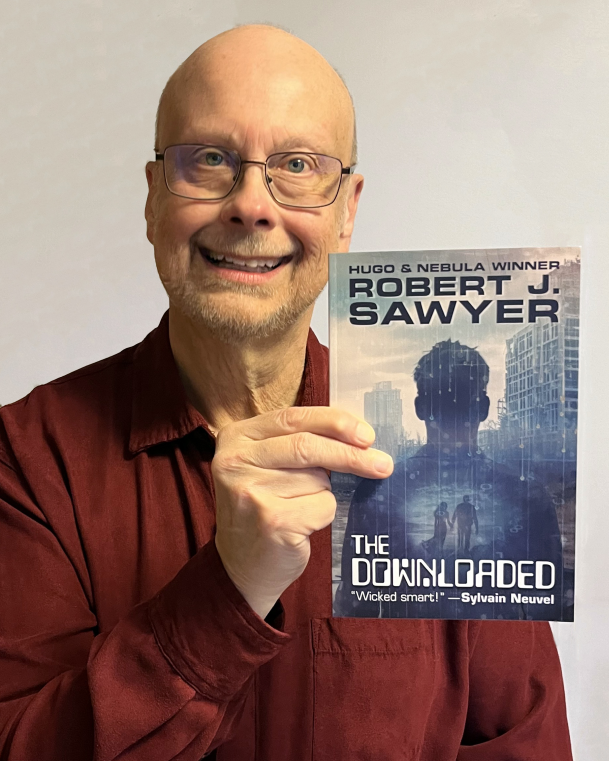
My 25th novel, The Downloaded, is now available for pre-order in both print and ebook editions, and I’ll be touring across Canada starting next month to promote its release.
Here are my May 2024 book-launch events: all are free and open to everyone, and books will be for sale (or bring your own copies and get them signed):
Calgary Public Library Central Branch 800 3rd Street SE, Calgary Alberta Tuesday, May 7, 2024, at 6:00 p.m. Please register in advance here
Audreys Books 10702 Jasper Avenue, Edmonton, Alberta Wednesday, May 8, 2024, at 7:00 p.m. More info
Hirut Cafe and Restaurant 2050 Danforth Avenue, Toronto, Ontario Saturday, May 11, 2024, 2:00 to 5:00 p.m. More about the venue
Kitchener Public Library Central Branch 85 Queen Street North, Kitchener, Ontario Monday, May 13, 2024, 7:00 p.m. Get your free tickets here
Word on the Lake Writers’ Festival Shuswap, British Columbia 17-19 May 2024 More info
McNally Robinson Grant Park 1120 Grant Avenue, Winnipeg, Manitoba Tuesday, May 21, 2024, 7:00 p.m. More info
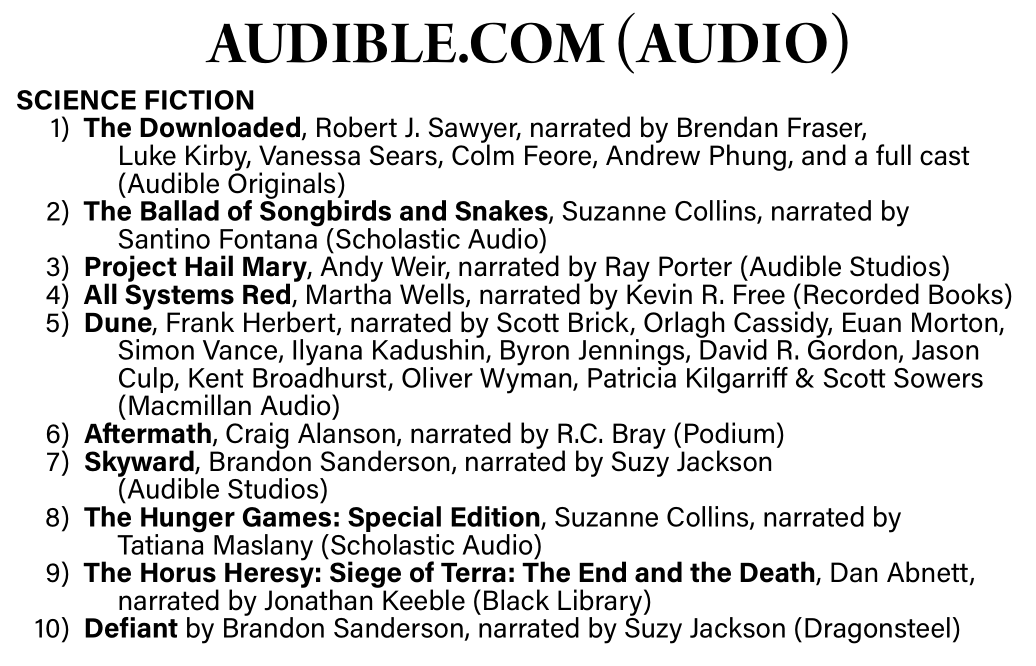
Delighted that my THE DOWNLOADED is the #1 Science Fiction bestseller on the Audible.com monthly bestsellers list as reported in the March 2024 issue of Locus, the trade journal for the science fiction and fantasy fields, which came out today.
I’m thrilled to announce new ebook editions of my Hugo Award-winning novel Hominids, its Hugo Award-nominated sequel Humans, and the bestselling final volume Hybrids. Together, they are the Neanderthal Parallax trilogy, which won the Canadian Science Fiction and Fantasy Award (“the Aurora”) for best workof the entire decade.
The trilogy tells of a parallel Earth where Neanderthals survived to the present day and we did not — and a portal that opens between the two realities, depositing Neanderthal quantum physicist Ponter Boddit at the Sudbury Neutrino Observatory in northern Ontario.
Each ebook is just US$4.99 or local equivalent, and they’re available at all major ebook vendors worldwide, including:
“Charming and provocative — some of the most outrageous, stimulating speculation since Robert A. Heinlein’s Stranger in a Strange Land questioned our tired, timid conventions.” —Publishers Weekly
“The Neanderthal Parallax is tremendous storytelling, with a convincing scientific basis, but at its core, it is science fiction as social commentary, worth reading for the quality of Sawyer’s vision and insight, the near-possibility of his scientific departures, and the depth of his social criticism.” —Quill & Quire
In honour of today being the 40th anniversary of the Macintosh computer, here’s an article I wrote in 1985 (the year I turned 25) for the Canadian computing magazine InfoAge (for which, back in the day, I was a regular contributor); of course, I wrote the article with WordStar on an Osborne 1 CP/M computer:
CanLit Mac-style
by Robert J. Sawyer
It’s Canada’s classiest print ad: a stunning Karsh group portrait of the biggest names in Canadian writing, including Charles Templeton, Margaret Atwood, Peter C. Newman and Ben Wicks, all clustered around a Macintosh computer. The caption? “Announcing the retirement of Canada’s most famous typewriters.”
McClelland & Stewart, the book company that bills itself as “The Canadian Publisher,” has signed a $500,000 deal with Apple Canada to make Macintoshes the cornerstone of M&S’s internal office-automation program. During the initial nine-month phasing-in, M&S will acquire 35 of the so-called Fat Macs, each with 512K of RAM, Apple LaserWriter printers, and the AppleTalk local-area network. Ten of the Macs will be used in-house by editors and managers. The remaining 25 will be presented to the top names in M&S’s writing stable. (Of the biggies, only Pierre Berton was already mousing his way through his books.)
Jack McClelland, the maverick king of Canadian publishers, is Chairman of the Board, Chief Executive Officer and President of M&S. Two years ago he decided that his company should be computerized. “M&S was attempting Herculean tasks using old-fashioned technology,” he says. “We needed an A to Z strategy which would bring us into the 21st Century.”
He turned to Yuri Rubinsky, Vice President, Consulting of Toronto’s SoftQuad. “Yuri is well on his way to becoming the industry’s high-tech guru,” according to McClelland.
Rubinsky had to find a computing answer that would not require people to relearn their jobs. “The solution had to be intuitive and very much related to the way they’ve been doing things all along. At the same time, we wanted to construct a kit of parts that would allow us to link all the elements of the publishing process together so that we could deal with everything from typesetting to book order entry on one computer.”
About the same time, Jack McClelland and Yuri Rubinsky independently settled on the Macintosh. “I started searching for a wordprocessor I could use,” says McClelland. “I’m about as inadept mechanically as anyone in the world. When it changes from standard to daylight time, the clock in my car remains standard until somebody else uses it. I tried a number of computers before I took Apple up on its ’Test Drive a Macintosh’ program. I was able to learn to use it in about three-quarters of an hour. I figured that if I could use it then our authors would be able to as well.”
McClelland knew there would be resistance to the arrival of the information age. “A lot of authors—particularly older authors—are wedded to their typewriters. We’re gradually weaning them away. Once they’ve seen the Mac working it’s amazing how quickly they change their opinion.”
At the heart of Rubinsky’s solution is the UNIX operating system, to be run on an as-yet-to-be-selected mini computer. The Macs will be used as both intelligent terminals and stand-alone devices.
“UNIX is a programmer’s dream,” says Rubinsky. “We can easily build modules that dump certain information into files to be downloaded into the Mac, used on spreadsheets, wordprocessing programs and so forth. The whole thing can be run with database management as the central theme. All stages in a book’s life—from conception through distribution—are fields in a record. Even the text of the book is just another set of fields.”
If the Mac hadn’t already existed, it would have been necessary to invent it, Rubinsky says. “We needed the control over the screen image that the Mac allows. Oh, we could have tried to create that same kind of intuitive interface just using UNIX by itself. We could have gone to Sun Micro Systems where it’s all built in, but that was simply too expensive a solution.”
“As part of our arrangement we’re giving our authors the Microsoft Word program,” says McClelland. “Word is very powerful and flexible: a heavy-duty product for people like us who live and breath syllables.”
Surprisingly, it was a public-relations firm that steered M&S towards Word. “When we learned that Apple and McClelland & Stewart were working together, we said ’geez, this might be an opportunity for Microsoft,’” says Ed Gould of BursonMarsteller, the PR company that handles Apple Canada, M&S and the Canadian office of Microsoft, which opened earlier this year. “McClelland & Stewart approached Apple directly. But we saw a missing link: software.
“The question was what is the absolute best program for the writer to use? And the answer was Microsoft Word. It’s the first choice in wordprocessing software, certainly in the Mac environment, and, many people say, in the IBM world, too. Microsoft was extremely pleased to provide all the writers with Word software. As well, Microsoft is going to be providing one-on-one individual training and technical support as requested.”
Dave Killins, President of Apple Canada, is also a Word fan. “Without question, Word is the definitive professional wordprocessing package. It hurts to admit it, but Word can run rings around our wordprocessor, MacWrite.”
Gould feels that this is the way of the future. “There’s got to be more of either these strategic alliances or participatory arrangements, bringing hardware and software together.”
For high-quality hardcopy, Rubinsky selected the new Apple LaserWriter, a 90,000-dots-per-square-inch printer based on the Canon laser print engine (See “The Speed of Light,” InfoAge January 1985). “We could have used other laser printers or, for that matter, used the Apple printer without the Macintoshes,” says Rubinsky. “There is an argument for Apple’s LaserWriter and there’s a separate argument for Apple’s Macintosh. Each is, separately, the best in its class.”
The near-typeset-quality of laser printing is particularly useful to publishers. “We’ll be using it to do galley proofs, running software that SoftQuad is providing, SoftQuad T ROFF. It’s a vastly improved version of the original UNIX type-formatting software. It will allow M&S to mimic an exact image of the finished copy on the LaserWriter, with hyphenation and justification. It will have kerning throughout [tucking one letter under the overhang of its neighbour for a tighter appearance], something no laser printer in this price range does. We will get the type to look serious enough that authors will say ’My goodness, this is the real thing.’ With dot-matrix printers, authors don’t take them seriously enough. When they see galleys they still want to make changes.”
The in-house Macs will be hooked up to the LaserWriters via AppleTalk, a small twisted-pair CSMA/CA local-area network that can connect up to 32 computers and intelligent peripherals over a distance of 1000 feet.
The weak link in the chain? “The file server,” says Rubinsky without hesitation. “It’s an unknown.” Apple’s file server will be a separate computer coupled to a high-capacity hard disk. It will act as crossing-guard for disk and file access across the AppleTalk network. In typical Mac-fashion, it’ll be available Real Soon Now.
“We’re prepared in the short term to live without it and treat the mini as the file server, but as soon as possible we want those file servers in there because we’re going to be using them as a protection mechanism,” Rubinsky says. Each department will have its own file server. “That will mean that no one in the wrong area will have direct access to the mini. You will be able to get information from other departments but they will not be on-line together. If you’re an author telephoning in a manuscript to M&S, you will not be able to bring the system down no matter how hard you try.”
In May, the first crate of Apples arrived at the publisher’s Toronto headquarters. “Editors are using them, but very cautiously,” says Rubinsky. “Most of them are still editing on printout.” At the same time, a pilot group of seven authors was presented with Fat Macs with Jack McClelland’s compliments.
SoftQuad has outlined a two-year phasing in of Mac technology at McClelland & Stewart. In the past, M&S’s heavy-duty computing was done on an out-of-house time-sharing basis. By the time you read this, that will have been replaced with an on-site minicomputer to be used for on-line sales reporting and product accounting. At this same time, the Macs will begin to take over the management of contracts, subsidiary rights and permissions sales.
“We’ll introduce Electronic Mail pretty early on as a kind of tease: something that shows the potential quickly,” Rubinsky says. “We’re easing the technology in. There will be no moment at which the whole place is suddenly computerized and mini-rebellions take place.”
Come October, LaserWriters will begin generating preview copies of manuscripts, invoices and royalty statements in-house. The Macs will become database managers for tracking manuscripts through all stages of the publishing and marketing process.
At the beginning of 1986, production cost estimating will be transferred to the Macs. Microsoft Word will take over all writing tasks in the publicity, scheduling and budgeting departments. Whenever a new book is being considered, the Macs will be used to research the sales history of similar works and of the author’s previous titles.
In the first half of next year, Macs running Multiplan will become intelligent terminals to the mini, which will be handling all accounting, order entry and inventory work. Reports will be generated weekly as both LaserWriter hardcopy and electronic mail. Final checks of typesetting will be done on LaserWriter copy.
Between July and October 1986, purchase orders and budget forecasting will go on-line.
By April 1987, all books will be prepared in-house as camera-ready copy, fed directly from the Mac to Linotype phototypesetters.
Now for the $64,000 question: what about IBM compatibility? “I think IBM is a machine of the past,” says Rubinsky. “Its time has come and gone. I had the pleasure of running into [Microsoft Chairman] Bill Gates at a conference in Dallas in January and he made it clear that, as far as he is concerned, MS-DOS has peaked and its on the decline from here on in. He figures that there’s about a year of life in it. He’s throwing all his weight behind ZENIX. I think the era of the single-user personal computer is over. People are realizing that they are sacrificing too much to have that IBM. People are too clever to be sucked in by IBM anymore: they’ve moved beyond IBM and are into serious computing.”
What about Apple’s rocky future? “For the price, Mac is the best intelligent terminal you can buy today,” says Rubinsky. “But I’d be prepared to dump the Macs in three to five years if they were no longer the right machine. The real investment is in the software—and it’s all UNIX. It’s completely portable. We could throw away any number of machines countless times but the data and the programming will still be intact. I don’t think that Apple’s financial problems are really that serious, but, if they are, we’d still be safe.”
Speaking of shaky foundations, what’s the perennially impecunious McClelland & Stewart doing spending $500,000 on high-tech marvels? Jack McClelland insists that, despite his company’s rollercoaster finances, the computers can pay for themselves. “We average between six and eight months from the time an author finishes a book to publication. We think we’re going to cut that in half. Very soon we will be going from the author’s Mac by modem to the editor’s Mac then back to the author with corrections then back again and right into type.”
McClelland sums up the move to Macintosh. “We think it’s going to save our editors and our authors a hell of a lot of time and money.” And that’s just as important in the business of Canadian culture as it is anywhere else.
___
Robert J. Sawyer has written for Books in Canada and Canadian Author & Bookman.
Forty years to the day after I wrote it, here’s the first thing I ever wrote in WordStar. This was published in The Bakka Bookie Sheet, the newsletter of Bakka, Toronto’s science-fiction specialty bookstore, and it provides an interesting snapshot of the state of Canadian science-fiction and fantasy publishing four decades ago:
1983 in Review: The Canadian SF Year
by Robert J. Sawyer
In September, Bakka published an amusing chapbook entitled Toronto’s Fantastic Street Names by John Robert Colombo.
Houghton-Mifflin published The Celestial Steam Locomotive, first volume of Michael Coney’s “The Song of Earth” trilogy, in November. Coney makes his home in Sidney, B.C.
Charles de Lint of Ottawa is well-known for his excellent semi-prozine Dragonfields, of which the fourth number appeared in 1983. But he has also taken the book-publishing world by storm, selling his first, second, and third novels this year: The Riddle of the Wren and Moonheart to Ace and The Harp of the Grey Rose to Starblaze.
Augustine Funnel of Lyndhurst, Ontario, wrote “Viewpoint: A Stroll to the Stars” in the August IAsfm.
Another fine collection by Phyllis Gotlieb, Son of the Morning and Other Stories, was released by Ace in December.
Terence M. Green made his first appearance in IAsfm with “Susie Q2” in August. He sold another story to F&SF. He reviewed Pauline Gedge’s Stargate and Spider Robinson’s Mindkiller in the February Books in Canada. Once again, Terry was an invited reader at the Conference on the Fantastic in the Arts in Florida.
Collector R. S. Hadji had annotated horror bibliographies in the June, August, and October issues of Twilight Zone.
Tanya Huff sold script outlines to a TV series in development stage called “Captain Lonestar. “ Her fantasy story “Claus Clause” was a runner-up in the annual CBC Radio Drama Competition.
David Kesterton, author of The Darkling, and Robert J. Sawyer both joined the Science Fiction Writers of America this year, bringing the total Canadian membership of that organization to 18.
Tsunami by Crawford Kilian of Vancouver was published by Douglas & McIntyre.
That brilliant novel Courtship Rite continued to garner honours for Donald Kingsbury. It was a nominee for the Hugo and Locus named it best first novel of the year. Kingsbury was flown to Balticon 17 in April to accept the Compton N. Crook memorial award. Forbidden Planet bookstore announced Don as winner of their first annual Saturn Award in the Best New Writer category.
Toronto doctor Edward Llewellyn’s third DAW Books novel, Prelude to Chaos, appeared in February.
Spider Robinson’s “Melancholy Elephants” won the Best Short Story Hugo. He signed autographs at Bakka in November.
In June, CBC-TV produced a version of University of Waterloo alumnus Thomas J. Ryan’s 1977 novel The Adolescence of P-1. The show, with screenplay by Barrie Wexler, will be broadcast in 1984 as part of the “For the Record” anthology series.
Montrealer Charles R. Saunders sold an Imaro sequel entitled The Quest for Cush to DAW.
Robert J. Sawyer’s article on semi-prozines was in the Fall Canadian Author & Bookman. His story “The Contest” was optioned by Bar Harbour films and his script “Earthfall” won an honourable mention in the annual Writer’s Digest Writing Competition. His mini-interview with Don Kingsbury appeared in February’s Books in Canada and he sold a long Kingsbury interview to Science Fiction Review.
Expatriate Canuck A. E. van Vogt completed a third Null-A book, which so far has only sold in French to a publisher in France. DAW Books published his Computerworld in November.
Andrew Weiner continued his prolific publishing of excellent stories: “One More Time” in the Doubleday anthology Chrysalis 10, “On the Ship” in the May F&SF, “Takeover Bid” in the June Twilight Zone, and “Invaders” in the October IAsfm.
McGill University’s Science-Fiction Studies produced issues on 19th century SF and SF in the non-print media. Bill Mark’s Vortex had four issues in 1983. A semi-prozine called Moonscape appeared, edited by Mogens Brondum of Swan River, Manitoba.
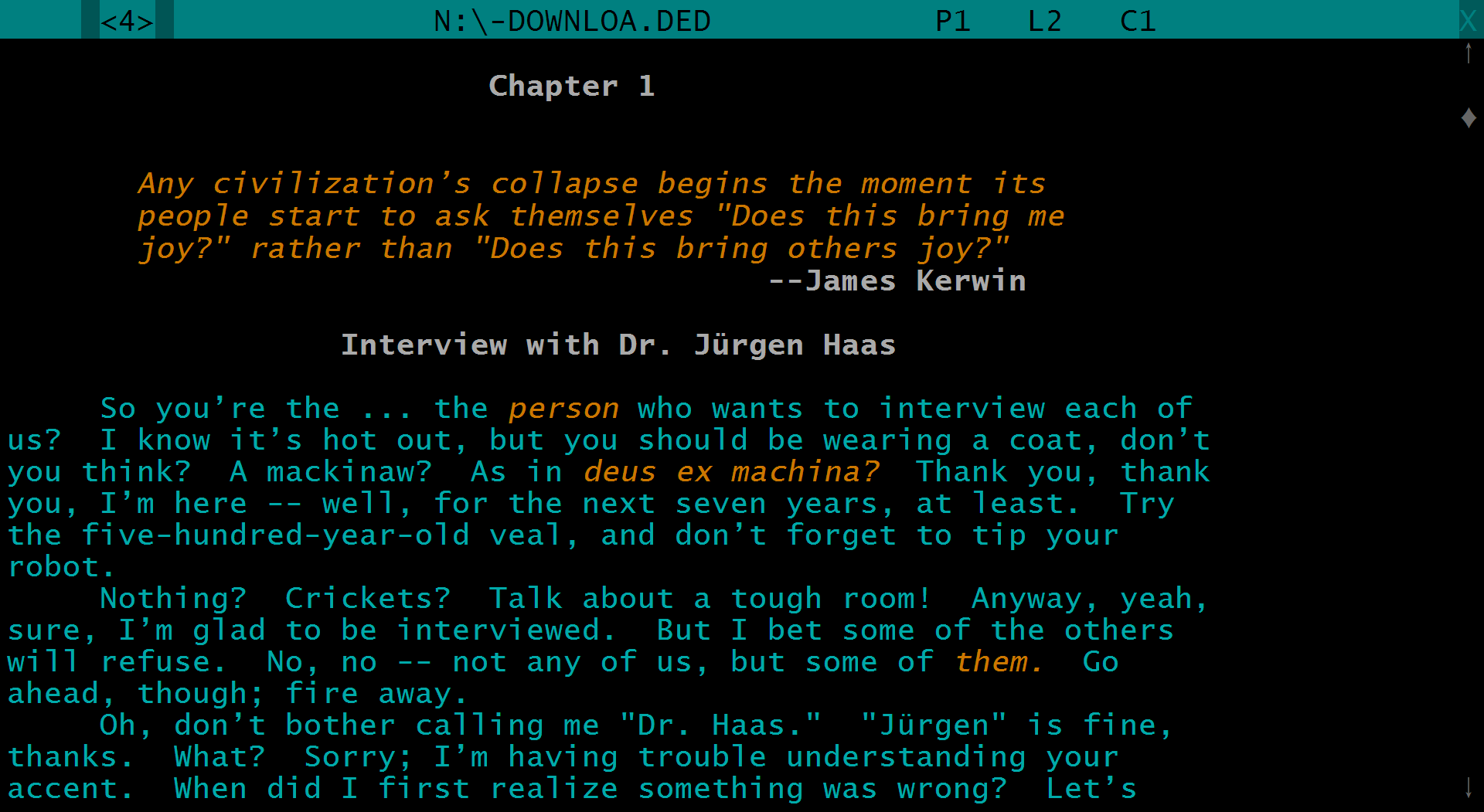
Forty years ago today, on December 16, 1983, I started using the word-processing program WordStar.
Two days earlier, I’d acquired my first computer, an Osborne 1B, which came bundled with the CP/M operating system, SuperCalc spreadsheet, Microsoft BASIC, and WordStar 2.26.
And, today, I still use WordStar: WordStar for DOS 7.0 Revision D, the final version ever produced. It has file-stamp dates of thirty-one years ago (December 21, 1992).
George R.R. Martin also still uses WordStar for DOS, but he stopped upgrading at version 4.0.
As Anne Rice said, “WordStar was magnificent. I loved it. It was logical, beautiful, perfect. Compared to it, MS Word is pure madness.”
And I do love it. I love that I can still open and edit files I wrote forty years ago with ease.
I love that it was designed for touch-typists: you never have to take your hands off the home typing row to do anything (yes, you can use a mouse or function keys if you wish, but you never have to).
I love that you can mark a block and then do something else before having to deal with it (unlike Word, where if you mark a block and then start typing, everything in the marked block is gone as Anne said, pure madness!).
I love that it lets me see (or hide) the formatting codes in the document (an idea WordPefect stole from WordStar, and something Word sorely lacks).
I love that it changes cursor shape so that I can tell at the insertion point whether I’m in insert or overtype mode.
I love that I can have italics in a different color than regular text, making it easy to see if a period or comma is italicized or not.
I love that it’s utterly distraction-free if you wish, with a minimalist screen.
I love that it provided a night-mode decades before Word offered such a thing.
I love that it’s freely installable on any computers I own, and that, with DOSBox-X, the emulator I use, it runs flawlessly under Windows, Mac, or Linux.
Years ago, I wrote a conversion routine that flawlessly converts WordStar files to RTF for flawless importation into Word, and I do that when I have to submit something.
I’ve written everything for the past forty years in WordStar: novels, short stories, articles, screenplays, teleplays, HTML code, and, yes, this very post. And I intend to go on using it for the rest of my life.
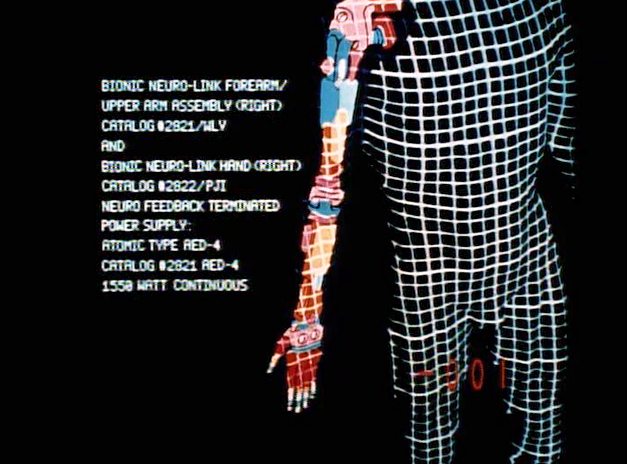
There doesn’t seem to be an accurate version of the specifications for cyborg Steve Austin’s bionic parts anywhere online, so I have put one together. Below are screen-accurate reproductions of the text.
The only change I made from Jack Cole’s faux computer-graphic displays used in the opening credits of The Six Million Dollar Man was to render the text in mixed case to improve readability; Cole used all upper case.
BIONIC EYE:
Bionic Visual Cortex Terminal Catalog #075/KFB 43MM O.D. F/0.95 Zoom Ratio: 20.2 to 1 2135 Line 60 Hz Extended Chromatic Response Class JC CLASSIFIED
BIONIC ARM:
Bionic Neuro-link Forearm/ Upper Arm Assembly (right) Catalog #2821/WLV and Bionic Neuro-link Hand Catalog #2822/PJI Neuro Feedback Terminated Power Supply: Atomic Type AED-4 Catalog #2921 AED-4 1550 Watt Continuous Duty Nominal Double Gain Overload Follower Class MZ CLASSIFIED
BIONIC LEGS:
Bionic Neuro-link Bipedal Assembly Catalog #914 PAH Neuro Feedback Terminated Power Supply: Atomic Type AED-9A 4920 Watt Continuous Duty Nominal Double Gain Overload Follower 2100 Watt Reserve Intermittent Duty Class CC CLASSIFIED
Long version: the downside of being an online pioneer! I sent out my first by-email newsletter 23 years ago (announcing the publication of Calculating God). I’ve never been aggressive about building an email list, but in the almost quarter-century since then, I’d accumulated about 6,000 subscribers.
But, of course, in all that time, a lot of people’s email addresses have changed (buh-bye, all those AOL and CompuServe addresses!) — and, as I was very sad to see, looking over my list, quite a few of my subscribers have passed away.
I’d been using PairList from Pair Networks (the company that hosts my website) forever, but they’re sunsetting that GNU-Mailman-based service, as messages sent through it often ended up in spam.
After some research, I decided that Substack — which offers free newsletter hosting and lots of excellent tools — should be my new way of sending out newsletters. I was all set to switch to them with the big announcement last month that my The Downloaded was now out (and free!) on Audible.
But Substack rejected (quite rightly, I suppose) importing my long-in-the-tooth subscriber list. Eventually, I did manage to come up with a list they would accept: the 1,300 names that had subscribed in recent years via my website link.
But 1,300 isn’t even a quarter of what I had before. If you were a subscriber but didn’t get the notice I sent out a while ago about The Downloaded, please re-subscribe.
And if you’ve never subscribed, please do! I only send out a newsletter a few times a year (none of this bombarding my readers every week stuff for me!) — and only when I have actual news to share.
Sixty years ago today, on November 22, 1963, American president John F. Kennedy was assassinated — an event that had a big impact on J. Robert Oppenheimer, as portrayed in this scene from my novel The Oppenheimer Alternative:
From Dallas, Texas, the flash apparently official: President Kennedy died at 1:00 p.m. Central Standard Time — two o’clock Eastern Standard Time — some thirty-eight minutes ago.
—Walter Cronkite
Vindication at last! Oppie sat at his desk in Fuld Hall, drafting his acceptance speech. Teller might have extorted the Einstein Award, and, yes, it had been Teller himself who had also received this honor last year. But now, finally, it was Robert’s turn: next week, he’d receive the Enrico Fermi Award, named for the Italian navigator who had passed away nine years ago. That it came with a tax-free $50,000 check was nice. The news announced just this morning, that President Kennedy would personally present the award to him, was definitely sweet. And the gold medal with Fermi’s likeness, looking down and to the left with that slight, shy smile Oppie remembered so fondly, would certainly be a keepsake.
But what mattered most was the organization that was sponsoring the award. The A.E.C., the goddamned Atomic Energy Commission, the same body that had stripped Oppie of his security clearance nine years ago, had now done a complete one-eighty and was about to bestow its highest honor, its prize for lifetime achievement, on J. Robert Oppenheimer! He’d be back in the canon of nuclear giants along with the previous recipients: Fermi himself (the only posthumous laureate), then von Neumann, Lawrence, Wigner, Seaborg, Bethe, and, yes, Teller.
Glenn Seaborg, who had shared the Nobel Prize for the discovery of plutonium, was the current A.E.C. chair, and Oppie had no doubt that it was he, along with Oppie’s White House supporters including Dean Rusk, McGeorge Bundy, and Arthur Schlesinger, Jr., who had ensured Oppie would be this year’s recipient: a full, public, presidential acknowledgement that the commission had been wrong, wrong, so-fucking-wrong in stripping him of his Q clearance. Seaborg had told Oppie that, when he informed his predecessor, Lewis Strauss, about the upcoming award, Strauss had looked like Seaborg had punched him in the face.
Verna was out, and she’d left the inner door to Oppie’s office open, but Oppie heard a knock on the outer door and, without looking up from the blue-lined pad he was writing on, he called out, “Come in!”
“Dad …”
He saw his son Peter, now twenty-two, tall and lean, a look of pure shock on his face. Oppie pushed back his chair, got up, and strode into the secretarial office. “Is Kitty —“
Peter raised a hand. “She’s fine. Dad, I just heard it on my car radio. President Kennedy has been shot.”
Robert felt as if a bullet were tearing into his own flesh. He averted his gaze and took hold of the edge of Verna’s desk to steady himself. “I — I need a drink. Peter?”
“God, yes.”
He staggered into the walk-in closet where a few bottles were always kept, and —
A bullet. A single bullet. History didn’t turn on atom bombs; it pivoted on shots from guns, whether it was the assassination of Archduke Ferdinand beginning the First World War, or Hitler’s own bullet to the brain ending the Second in Europe, or, now, with the person who’d challenged the nation to put a man on the moon by the decade’s close, who’d stared down Khrushchev during the Cuban Missile Crisis when the world was truly at the brink of nuclear annihilation: shot, fate unknown. Alive; dead. Schrödinger’s cat, with the future hanging in the balance.
“Dad …?” said Peter. Oppie heard him but still just stood there, staring at the bottles arranged on the top of a small safe, glass rockets poised for launch.
“It’s okay, Dad,” said Peter again. “Never mind, then.” Oppie felt his son’s hand on his forearm leading him out of the closet into the room and helping him find a seat.
Verna came running in. “My God, did you hear?”
Oppie raised his head but he sounded far-off even to himself. “Peter says the president’s been shot.”
“Not just shot,” said Verna, her voice breaking. “They just announced it. He’s dead.”
Oppie sat for a moment listening to the barrage of his own pulse. “Well, then,” he said, his head swimming. “Well, then.” He was quiet for a time but at last rallied some strength. “Verna, can you knock on all the office doors? Tell everyone to go home, be with their families.”
She nodded and left.
“And, Peter, maybe … maybe you can drive me home?”
“Of course, Dad.”
But Oppie continued to just sit there, face propped up by his hands, bony elbows on the chair’s arms. “Now,” he said softly, “things are going to come apart very fast.
Got an Audible account? The Downloaded, the twenty-fifth novel by Hugo Award-winning author Robert J. Sawyer, came out today in a six-month exclusive window as an audiobook on Audible—and it’s FREE to anyone who has an Audible account! It’s part of the Audible Plus catalogue and therefore doesn’t require an Audible audiobook credit to add to your library. Grab it here:
* And in Audible markets around the world! (There’s also a French-language version!)
Yes, The Downloaded will be out in print and ebook forms, but not until May 7, 2024 (once Audible’s exclusivity period ends), but you can hear the whole novel right now for free on Audible!
What’s more, we have an absolute dream team of narrators for this audiobook; Audible has spared no expense! The Downloaded is narrated by Academy Award-winner Brendan Fraser, Emmy Award-winner Luke Kirby, Dora Mavor Moore Award-winning Broadway actress Vanessa Sears, Kim’s Convenience star Andrew Phung, and Gemini Award-winner and Canadian theatre legend Colm Feore.
Here’s what it’s about:
In 2059 two very different groups have their minds uploaded into a quantum computer in Waterloo, Ontario. One group consists of astronauts preparing for Earth’s first interstellar voyage. The other? Convicted murderers, serving their sentences in a virtual-reality prison. But when disaster strikes, the astronauts and the prisoners must download back into physical reality and find a way to work together to save Earth from destruction …
Check out the behind-the-scenes video with Brendan Fraser, Luke Kirby, and Robert J. Sawyer:
“The Downloaded absolutely sizzles with fascinating ideas.” —Robert Charles Wilson, Hugo Award-winning author of Spin
“A wicked-smart thrill ride from start to finish. I loved it.” —Sylvain Neuvel, bestselling author of A History of What Comes Next
“The Downloaded is a wonderful demonstration of Sawyer’s deep understanding of—and compassion for—people. It’s a rare and potent humanity that elevates his work high above the rest.” —Julie E. Czerneda, Aurora Award-winning author of To Each This World
“InThe Downloaded, Sawyer proves he’s not just a master at using science fiction to address social issues but also a master at portraying diverse characters.” —James Alan Gardner, Theodore Sturgeon Award-winning author of Commitment Hour
“One of the best SF novels I’ve read in years.” —Allen Steele, Hugo Award-winning author of Coyote
If you’re in Canada, you might see or hear the national TV and radio advertising Audible is doing for The Downloaded. They have been fabulous to work with and are treating The Downloaded as a major release for them.
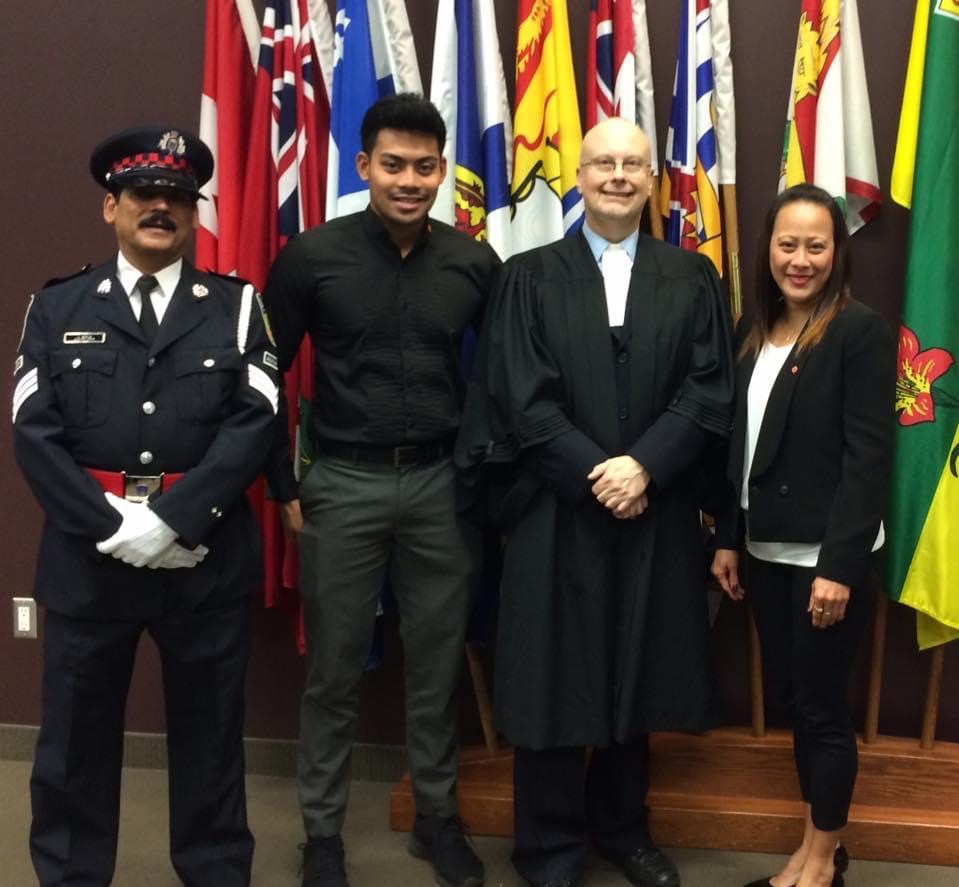
I was asked in Chengdu about diversity in Canada. It’s one of the things I love most about my country; I’ve always said it’s like the bridge of Kirk’s Enterprise writ large: everyone is welcome here and everyone is equal. Although I’m thrilled to be guest of honour at Chengdu Worldcon, the greatest honour of my life, as a member of The Order of Canada, has been personally swearing in thousands of new Canadian citizens from across the globe.
I don’t wear jewelry, but if I did, I’d wear a Vulcan IDIC (Infinite Diversity in Infinite Combinations) pendant. As Miranda Jones said to Spock when he was wearing his:
MIRANDA: I understand, Mister Spock. The glory of creation is in its infinite diversity.
SPOCK: And the ways our differences combine to create meaning and beauty.
The Canadian publishing trade journal Quill & Quire just reported that Sharon Fitzhenry, the CEO and majority shareholder of Canadian publishing company and book distributor Fitzhenry & Whiteside, passed away on August 26, 2023, at the age of 73.
Sharon and I had worked together since 2005, when she acquired the smaller Calgary-based Red Deer Press, for which I was then editing a science-fiction line called (their idea, not mine!) Robert J. Sawyer Books.
After Sharon took over, besides continuing to edit books for my imprint by Canadian SF heavyweights including Terence M. Green, Matthew Hughes, Phyllis Gotlieb, and Karl Schroeder, plus Americans Fiona Kelleghan and Nick DiChario, I also edited an anthology I’m very proud of for her: Distant Early Warnings: Canada’s Best Science Fiction.
Ten years ago today, on September 13, 2013, the biggest and best academic conference about Canadian science fiction ever held began.
McMaster University in Hamilton, Ontario, hosted the three-day conference entitled “Science Fiction: The Interdisciplinary Genre — A Conference in Honour of Robert J. Sawyer’s Archival Donation to the University Library Collections.”
My archives, which were certified by the Canadian Cultural Property Export Review Board as being of “outstanding significance and national importance,” were added then to McMaster’s extensive archival holdings, which include:
• a massive collection of Bertrand Russell material,
• a large H.G. Wells collection,
• and extensive material related to Canadian literature, including the papers of Pierre Berton, John Robert Colombo, Margaret Laurence, Farley Mowat, and publisher Jack McClelland.
As the flyer for Science Fiction: The Interdisciplinary Genre put it:
The biggest and best academic conference ever focusing on Canadian science fiction:
Authors? We got ’em: Hugo Award-winner Robert J. Sawyer, Aurora Award-winner Julie E. Czerneda, Aurora Award-winner Élisabeth Vonarburg, and Hugo Award-winner Robert Charles Wilson.
Editors? The most important ones in the history of Canadian SF: Order of Canada member John Robert Colombo (editor of the seminal Other Canadas) and Hugo Award-winner David Hartwell of Tor Books.
Academics? Of course! From all over North America! In all areas of academic study! Just a small sampling of the speakers:
James Christie, Faculty of Theology, University of Winnipeg, on “Remembering the Future: Science Fiction and the Emerging Art of Dialogue Theology”
Carrie J. Cole, Department of Theater and Dance, Indiana University of Pennsylvania, on “Science and the Staging of the Speculative Imagination: Interdisciplinary and Intertextual Performance Strategies”
Herb Kauderer from Hilbert College, Hamburg, New York, on “Fedora Hats and the Great Gazoo: Pop Culture References in Robert J. Sawyer’s novels Triggers and Red Planet Blues“
James A. Novak, Department of Philosophy, University of Waterloo, on “Consciousness in the works of Robert J. Sawyer”
Wendy Gay Pearson from Western University, London, Ontario, on “Queer Time, Postcoloniality, and Canadian SF”
Amy J. Ransom from Central Michigan University on “Hockey & Science Fiction in Canada: A Combination Seen Rarely But in Québec”
Sherryl Vint from University of California Riverside, on “To Corrupt and Control the Present in Order to Win the Future: Continuum as Post 9/11 Television”
In total, 35 papers were accepted for the conference, and a dozen of them are online at McMaster; there’s a link to them on the conference website, which also had the original call for papers, the PDF of the program book, and links to post-conference coverage:
The opening credits for The Six Million Dollar Man were created by the legendary Jack Cole, and they use radio chatter during the crash sequence of the lifting body Steve Austin is operating that was never actually heard in the pilot movie.
There’s been lots of debate online about what the dialog actually says, with one line variously interpreted as:
“Trim selector: emergency.”
and
“Threat selector: emergency.”
I’ve always heard it as the former. And in the episode of The Six Million Dollar Man called “The Rescue of Athena One,” written by Star Trek‘s D.C. Fontana, there’s different but very similar dialog, and there, you can CLEARLY hear that it’s “trim selector,” not “threat selector,” and the closed captions (admittedly added decades later) are quite clear that the word is “trim” indeed, it’s used twice:
348 00:18:46,993 –> 00:18:48,324 CAPCOM: Okay for pass.
349 00:18:48,394 –> 00:18:50,294 Correction. Alpha hold is off, Rescue.
350 00:18:50,363 –> 00:18:51,728 Trim selectors slipping.
I no longer write short stories, but I had a nice little career as a short-story writer, with 45 stories published. The stories appeared in a mix of classic genre venues such as Analog, Amazing Stories, and On Spec, original anthologies, and places that don’t normally publish fiction, such as The Toronto Star, The Globe and Mail, Leisure Ways, and The Village Voice.
My stories were nominated for the Hugo, Nebula, and Bram Stoker Awards; won Science Fiction Chronicle‘s Reader Award for best short story of the year; won Analog‘s Analytical Library Award for best short story of the year in that magazine; won five Aurora Awards; won France’s and Spain’s top SF awards; won CompuServe’s Homer Award, and won an Arthur Ellis Award from the Crime Writers of Canada.
I had a story in the journal Nature; had a story read on CBC Radio; had a story produced as a planetarium starshow; had stories optioned for film; and had work reprinted in Hartwell’s Year’s Best SF and in The Penguin Book of Crime Stories.
My short fiction has been praised as everything from “quietly intelligent” (Booklist) to “gobsmacking” (Publishers Weekly) and “highly entertaining” (Quill & Quire).
In a different review, Booklist said: “Sawyer’s collection showcases not only an irresistibly engaging narrative voice but also a gift for confronting thorny philosophical conundrums. At every opportunity, Sawyer forces his readers to think while holding their attention with ingenious premises and superlative craftsmanship.”
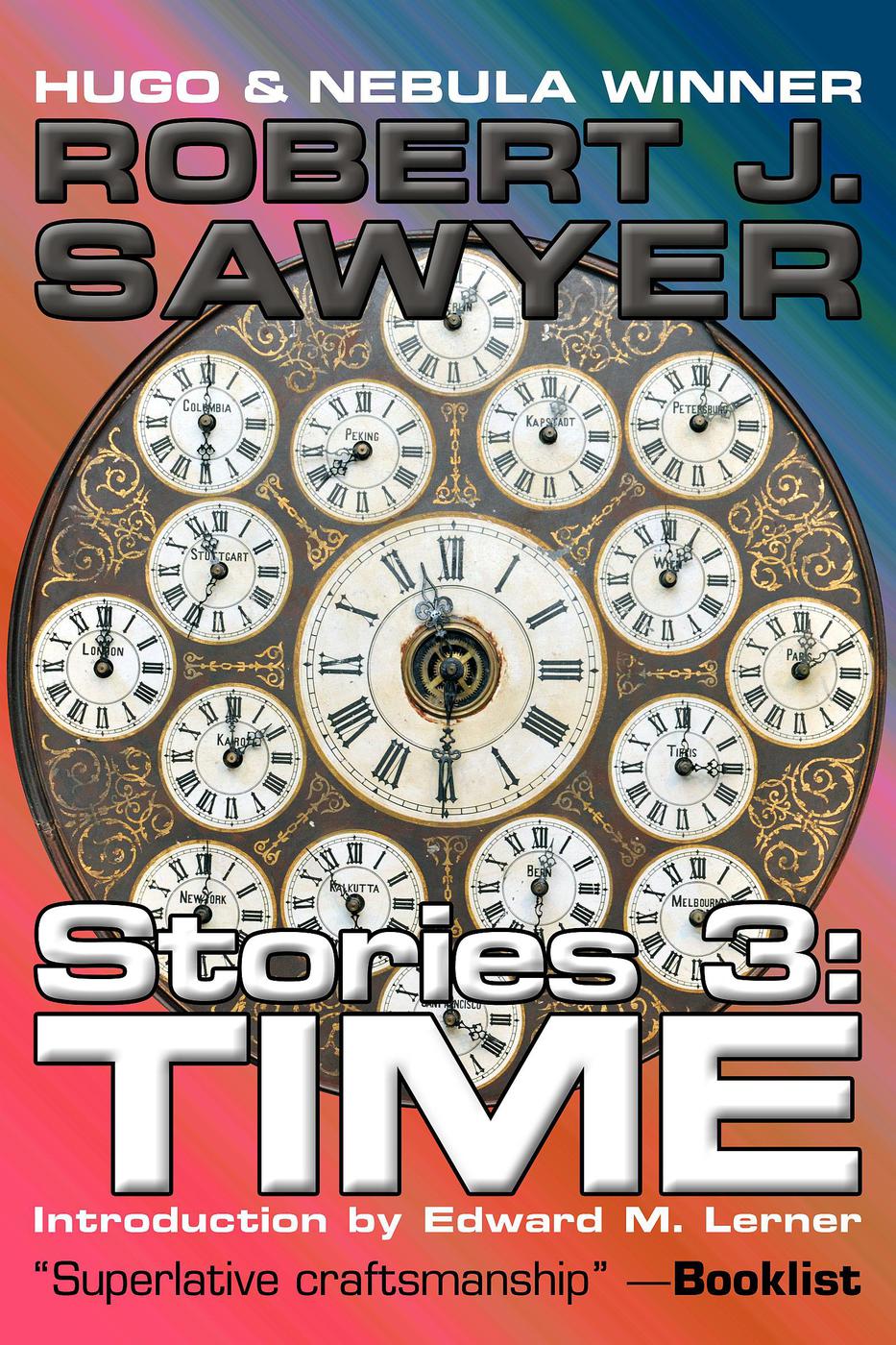
And now all of my short fiction is now available in three themed ebook collections:
Volume 1: Earth, with an introduction by James Alan Gardner
Volume 2: Space, with an introduction by Robert Charles Wilson
Volume 3: Time, with an introduction by Edward Lerner
They’re available on Kindle, Kobo, Nook, etc., worldwide for US$3.99 (or local equivalent) each. Every story has introductory background notes by me.
Today’s mail brought my contributor’s copy of the just-published anthology State of the Ark: Canadian Futurefiction. I’m delighted to see that editor Lesley Choyce used my “Star Light, Star Bright” as the lead story in this follow-up to his landmark 1992 anthology Ark of Ice: Canadian Futurefiction (which I was also published in).
Contributors to State of the Ark besides myself include Candas Jane Dorsey, Élisabeth Vonarburg, Tim Wynne-Jones, Katherine Govier, Jean-Louis Trudel, Terry Favro, Julie E. Czerneda, and Spider Robinson. This book should definitely be a contender for the best-related-work Aurora Award next year.
Yesterday, my great friend John Robert Colombo (pictured on the right with me at the 2009 Worldcon in Montreal) was inducted into the Canadian Science Fiction and Fantasy Hall of Fame. I was one of those who nominated him; this was my nominating letter:
It is my privilege and honour to nominate John Robert Colombo for the Canadian Science Fiction and Fantasy Hall of Fame. I am nominating him in the “non-writer” category, as he is principally an editor and compiler.
John is a towering presence in Canadian letters. He is a member of the Order of Canada and is Canada’s premiere folklorist and collector and compiler of Canadiana (best known for his seminal Colombo’s Canadian Quotations and its sequels) as well as a significant poet, broadcaster, publisher, and editor.
Although he has over 200 books to his credit, it is his twenty pioneering works in the field of Canadian speculative fiction that are my reasons for nominating him, most significantly his massive historical retrospective Other Canadas: An Anthology of Science Fiction and Fantasy, published in 1979, forty-four years ago, by McGraw-Hill Ryerson. It was the first-ever anthology of Canadian science fiction and fantasy, a beautiful hardcover gathering 21 fiction pieces and 28 poems drawn from 400 years of Canadian history:
Prior to that book, no one had made the case that there was such a thing as Canadian science fiction and fantasy: it was John who proved to Canada’s publishers, editors, academics, writers, and readers that the field actually existed. When my wife Carolyn and I edited Tesseracts 6, we dedicated the book thus:
“To John Robert Colombo, whose pioneering Other Canadas blazed the trail for all the Canadian science fiction and fantasy anthologists who followed.”
Among John’s other significant genre books are:
•Mostly Monsters (1977), a collection of “found poetry”—prose text that Colombo has rearranged as verse, gathered mostly from SF sources;
•Friendly Aliens (1981), a collection of thirteen SF stories by foreign authors set in Canada;
•Years of Light: A Celebration of Leslie A. Croutch (1982), a biography of Canadian fanzine publisher Croutch (1915-1969), as well as a general look at SF fandom in Canada;
•Worlds in Small (1992), an anthology of stories of fifty words or less, most of which are SF; and
•Tesseracts 14: Strange Canadian Stories (2010, co-editor).
John has also published several significant genre bibliographies and he has the distinction of being the first-ever academic keynote speaker at a World Science Fiction Convention, the 2009 Worldcon in Montreal.
His manuscripts and papers, certified as being of “outstanding significance and national importance” by the federal government’s Canadian Cultural Property Export Review Board, are housed at the McMaster University library, alongside those of Pierre Berton, Margaret Laurence, Farley Mowat, Canadian publisher Jack McClelland, Bertrand Russell, myself, and—yes—H.G. Wells:
John was instrumental in founding, in 1982, what was then called The Friends of the Spaced-Out Library, and is now The Friends of the Merril Collection of Science Fiction, Speculation and Fantasy. He was also a mainstay of Hydra North (later renamed Ontario Hydra), Canada’s first association of SF&F professionals, hosting seven of that organization’s 38 meetings in his home:
And, on a personal note, John was the first member of the Canadian literary establishment to take my own contributions to science fiction seriously. In 1982, he published new stories by myself and two other then-emerging writers, Andrew Weiner and Terence M. Green, in Leisure Ways, the magazine of the Canadian Automobile Association:
Born in Kitchener, Ontario, in 1936, turning 87 years young on March 24, 2023, and still active, it’s high time that John Robert Colombo be inducted into the Canadian Science Fiction and Fantasy Hall of Fame, which, after all, honours a field of literature that he himself was the very first person to ever recognize.
We saw Christopher Nolan’s movie Oppenheimer last night as it was meant to be seen: in 70 mm IMAX.
It’s a very good film; I recommend it. That said, is it the best cinematic treatment of the subject? No, that’s still the 1989 movie Day One.
And is Cillian Murphy going to win the Academy Award for Best Actor? No, I don’t think so; his is an awfully one-note version of Oppie, who was much more complex (and much more charming) than Murphy’s portrayal would indicate.
But I do predict there will be an acting Oscar for this film — and that it will go to Robert Downey Jr. for his subtle, perfectly controlled, and masterful portrayal of Lewis Strauss.
Matt Damon surprised me at how good a portrayal he brings in of General Leslie R. Groves, and Benny Safdie is pitch-perfect as Edward Teller.
But Nolan gives short-shrift to almost all the other scientists — the larger-than-life but real characters I had so much fun portraying in my novel The Oppenheimer Alternative. For instance, Richard Feynman is reduced to a guy in a couple of shots playing bongos in the background.
And, if I may be so bold, for those real-life scenes that appear in both Nolan’s Oppenheimer and my The Oppenheimer Alternative, my portrayals are more historically accurate. I refused to change any of the things Oppenheimer actually said or did; Nolan had no compunctions about that.
Nolan portrays Oppenheimer — a man so out of touch with common people that he’d been utterly unaware of the Great Depression even though he was twenty-six in 1930, a man who never voted in any election until he was thirty-two years old — as if he had been a sophisticated political activist, which simply wasn’t the case.
And the inciting incident Nolan came up with for the film — the first scene with Oppie, Einstein, and Strauss — is a wholly fictitious, and, frankly, unnecessary embellishment.
Also, despite all the pre-film buzz about full-frontal nudity, there actually is none in the movie (you see Florence Pugh‘s breasts in a few shots, and that’s it). The nudity was unnecessary yet ended up getting the film an “R” rating in the States, which is a pity; young people should see this movie, too.
But, yes, I recommend the film, and I’ll be buying the 4K disc when that comes out. Still, I suspect it’s a film I’ll only ever watch one more time (unlike Day One, which I’ve watched repeatedly). Despite the 180-million-dollar budget, most scenes in Oppenheimer actually aren’t very memorable either emotionally or visually.
The atomic age began 78 years ago today, on July 16, 1945, with the first-ever atomic bomb explosion, the Trinity Test near Alamogordo, New Mexico. This is how I described that momentous event in my novel The Oppenheimer Alternative:
I am sure that at the end of the world—in the last millisecond of the earth’s existence—the last human will see what we saw.
—George Kistiakowsky
At 5:29 on Monday morning, July 16, 1945, the one-minute-warning rocket twisted up into a predawn sky, adobe-pink to the east, stygian to the west.
“Lord, these affairs are hard on the heart,” Oppie said as much to himself as to the other men present—and then, tilting his head, conceded that there really had never before been such an affair. He gripped a rough-hewn oak beam with one hand, his fingers wraith-like. With his other hand he held the four-leaf clover Kitty had given him before he’d left for this test site, a place he himself had code-named “Trinity.” Although a trained botanist, his wife still felt there was luck in a mutant plant.
Thirty seconds later, four blood-red lights flashed on the console in front of Oppie in the concrete bunker ten thousand yards south of—a neologism, words shoved together like protons in a nucleus—“ground zero.” On his right a young physicist from Harvard stood by the knife switch that if opened would abort the test. The thing had its own momentum now, an electric timer ticking away; no one would go down in history as the individual who had set off the first atom bomb, but one man could still stop it.
The team at Los Alamos had come up with two different bomb designs. The first was a simple uranium-gun scheme deemed so foolproof that, as Leo Szilard had observed to Oppie, it didn’t require any testing. But Uranium-235, despite all efforts to efficiently separate it from U-238, was still available in such minuscule amounts that a second system was developed that instead used plutonium, which could be produced in comparatively large quantities. The alternative design required much more complex bomb hardware, and that was what they were about to test. Bob Serber had dubbed this spherical bomb type “Fat Man,” after the Sydney Greenstreet character in The Maltese Falcon. It used a revolutionary implosion system perfected—or so it had seemed until two days ago—by George Kistiakowsky. But a trial run early Saturday in the Pajarito Canyon, using a dummy Fat Man with a core of conventional explosives, had failed.
In the real Fat Man to be fired today, the plutonium core had been molded into a sphere the size of a softball. Surrounding it was a shell of thirty-two explosive castings called “lenses” because they’d been engineered so that the force of their explosions would be focused on the central sphere. With each lens detonating simultaneously, the spherical shockwave blowing inward should implode the core to tennis-ball size, forcing the plutonium into criticality. But the lenses in Saturday’s test bomb had apparently developed astigmatism.
Leslie Groves, military head of the Manhattan Project, and Vannevar Bush, in charge of the Office of Scientific Research and Development, and therefore its civilian head, had arrived as scheduled Saturday noon, and both were furious at the news.
Oppie tried to keep his cool in front of them—in front of everyone—but it finally all proved more than he could take. So much work, so much time, so near to success, but instead of a bloom of light, nettles in his fist. He’d broken down in front of Kistiakowsky, his tears the only moisture this desiccated area inauspiciously known as La Jornada del Muerto, The Workday of the Dead, had seen in weeks.
Kisty contended the failure was perhaps due to the use of substandard lenses, the best castings—free of significant bubbles and cracks—having been saved for the real thing, and he bet Oppie a month’s salary against ten dollars that everything would go fine today.
Late last night, Oppie, having recovered his composure enough to wax philosophic, had shared his own translation of a passage from the seven-hundred-stanza Bhagavad Gita with long-faced, bespectacled Vannevar Bush and visiting advisor I.I. Rabi, compact and trim, who had won last year’s Nobel Prize in physics:
“In sleep, in confusion, in the depths of shame,
“The good deeds a man has done before defend him.”
But rain, sheets of it, torrents, had begun at oh-two-hundred hours, the very heavens weeping.
Right now, Truman, Churchill, and Stalin were arriving at Potsdam, near Berlin, for the first Allied-leaders’ summit since the Nazi surrender. Truman desperately wanted a successful test so that he—the Commander in Chief, as Oppie had said, not some back-door sneak—could tell the Soviet premier that the Americans now had a working atomic bomb whose imminent use on Japan would surely end the Pacific war. The test had to go ahead now—but rain would drive radioactive particles down to the ground instead of letting them dissipate.
Groves loudly excoriated the meteorologist—who had, in fact, clearly warned the general days ago of the impending storm. Still, the man now felt the torrent would abate by dawn. Groves growled, “You’d better be right or I’ll have you hanged,” and he made the hapless soul sign his written forecast.
Then, just before 3:00 a.m., Groves got on the phone to the Governor of New Mexico, a servant rousting the sixty-six-year-old from bed. Oppie heard only the general’s side of the conversation: he told the governor, who was learning of the imminent test for the first time, that he should be prepared to “invoke martial law come dawn if the thing does more damage than we anticipate.”
Oppenheimer and the rest stepped outside, leaving only the person manning the abort switch. Groves, Teller, Feynman, and Fermi—the Italian navigator himself, who had moved to Los Alamos from Chicago last year—were scattered along with many more men at three of the cardinal points; the general had insisted on dispersal of the team so that if something did go wrong at least some essential personnel might survive.
At 5:29:50—with a mere ten seconds to go—a final warning gong sounded, an Oriental instrument signaling looming American triumph. Oppie took his piece of #10 welder’s glass from his pocket. “Five!” said a male voice over the external loudspeaker. “Four!” Oppie found his lungs paralyzed. “Three!” His heart, though, was pounding hard enough to shake his whole body. “Two!” He held the deep-amber glass up, his blue eyes reflecting back at him as green—“One!” —the same green, he realized with a start, as Jean Tatlock’s.
Light! Fierce. Pure. Blinding.
The cruel brightness, immediately unbearable, kept increasing. Silent light, holy light—not a sound to it yet but an intensity no one on earth had ever before experienced. For the first time, humans were doing what only the stars themselves had previously wrought, converting matter directly into energy, Einstein’s E=mc2 graduating from mere textbook formula into a devastating weapon.
The dome of blinding light grew and grew; Oppie estimated it was now a mile, now two, now three in diameter. And the color, which had started as pure white, then yellow, then a cacophony of hues, had now settled on an actinic purple, a radiant bruise on the firmament.
And then the light rose up—by God, yes, on a giant stalk, the hemisphere being pushed higher and higher, hell meeting heaven. Oppie hadn’t expected that; no one had. It looked for all the world like an incandescent parasol, a mushroom of flame, miles tall.
And, at last, a thunderous crack! as the sound of the explosion hit them. Hands flew up to ears; eyes that had endured the brightness behind opaque glass winced at the volume. Oppie had done the math in advance: he knew it was therefore now twenty-five seconds after the timer had reached zero, but it felt like many minutes.
Next came the blast’s scalding wind. Robert, incredibly, managed to keep erect; the more substantial Kisty, off to one side, was blown over but soon picked himself up and pushed against the gale to make it over to his boss. “You owe me ten bucks!” he shouted, his balding head split by a wide grin as he slapped Oppie on the back.
Oppie pulled out his wallet only to find it empty. “You’ll have to wait!” he shouted.
Someone else was making his way over to him: Ken Bainbridge, the test-site director, with a serpent-like mouth. “Now we’re all sons of bitches!” he yelled over the roar.
Yes, thought Oppie. We surely are. We’ve changed the world, won the war, and thrown down a marker in time: the whole, vast past was prologue; everything henceforth is part of a new epoch, a new period, a new era. The previous eras had been named for the ever-more-sophisticated animal life that had emerged in them: Paleozoic, Mesozoic, Cenozoic. But this new one had as its hallmark not unbridled biology but harnessed devastation.
The crowd around him was jubilant. Everyone was going to want to speak to him, he knew: to shake his hand, to offer congratulations, to share their views. But he needed a moment of peace as the weapon to end all war continued to assault the very sky in front of him. Oppie stepped away, walking sideways, keeping his eyes, no longer requiring the protective glass, on the great bulbous apparition.
Now …
Such a devilish thing! There were still afterimages, true, but there was also, superimposed in Oppie’s mind, a conjured city centered at ground zero, ceasing to be, incinerating into nothingness.
Now I am …
Robert’s primary education, at Felix Adler’s Ethical Culture School—the abstract made concrete, that school of philosophy given brownstone-and-mortar reality—had elevated his thinking, and Hindu mysticism had given him insights few of his Western contemporaries shared.
Now I am become Death …
Oppie had studied Sanskrit under the great Arthur Ryder so he could read the Bhagavad Gita in the original, and he thought as easily in that Hindu tongue as he did in English … or French, or German, or Dutch. He suspected that whatever language he used shaped his thoughts: German, with its compound nouns, was appropriate to the unification of physical forces; English, with its heavy freight of adjectives, was about one thing modifying another.
But Hindi—the Gita—was about deep connections, and its words, those terrible, portentous words, erupted in his consciousness as the towering maelstrom continued to roil the sky.
I have a metric ton of programming at Pemmi-con, the North American Science Fiction Convention, which starts in four days in Winnipeg, including a joint session with my old pal paleontologist Phil Currie (pictured). Come join me at these events:
Here’s your chance to quiz genuine Canucks about our great country. Once you’re done with the convention, where else can you go? What questions do you have about Canada? What surprises are in store for visitors, or even those who may have thought about setting up shop here?
Robert J. Sawyer, Gillian Clinton, Terry Fong (CanSMOF) (moderator)
How do you write for TV/Movies/Radio? Do you write first for the printed word first and then adapt? How do you launch your career into that lucrative and that will land you those fast cars we keep hearing about?
Tanya Huff, Robert J. Sawyer, Wendy Van Camp, Heather Jones (moderator)
One thing that sets SF/F apart from most writing genres is the fact that the fiction is set in a world that is almost entirely imagined. Some stories in this genre are in fact better-known for their settings than for their literary quality. Given the importance of worldbuilding to this writing, how much work does a writer have to do in order to make the story work? How do you know when it’s time to stop worldbuilding and settle down to writing? What are some examples of successful worldbuilding, and what are examples where the world overwhelms the story?
Jennifer Landels (Pulp Literature Press), Robert J. Sawyer, Gerald Brandt, Heather Jones (n/a)
===
Working with Social Media
Format: Panel
21 Jul 2023, Friday 16:00 – 17:15, York 4 (RBC Convention Centre Winnipeg)
Social media (SM) is now an important tool to authors, publishers and business in general. What are the dos or don’ts? Can you succeed without a SM presence? How helpful is it to create a loyal fanbase large enough to earn a living from or to otherwise succeed
(Focus is on how Social Media can aid a writer’s career)
Robert J. Sawyer, Wendy Van Camp, Marah Searle-Kovacevic (Buffalo in 2024 NASFiC bid), Tanya Huff
Panellists talk about their experiences with, and relationships to, editors and editorial intervention. The focus is on the positive: experiences that made the works better than they had been, and possibly even taught the writer something.
Karl Schroeder, Robert J. Sawyer, Sandra Bond (TAFF (2023 delegate), Edward Willett
===
Masterclass: A Thematic Approach to Science Fiction Writing
Author of #1 bestseller available for interviews tying into Christopher Nolan’s summer blockbuster movie OPPENHEIMER
As this summer’s hottest blockbuster movie Oppenheimer is about to open, you’re going to need someone to talk about J. Robert Oppenheimer, the father of the atomic bomb, and we have the expert you’ve been looking for.
Bestselling futurist ROBERT J. SAWYER has been called “Canada’s answer to Michael Crichton” by The Toronto Star and “a writer of boundless confidence and bold scientific extrapolation” by The New York Times. His latest novel THE OPPENHEIMER ALTERNATIVE covers the life and secret history of J. Robert Oppenheimer, the character being played by Cillian Murphy in Christopher Nolan’s summer blockbuster film, which opens worldwide on Friday, July 21, 2023.
Sawyer did two years of full-time research on Oppenheimer and the atomic-bomb effort before writing his novel, and other experts agree Sawyer knows what he’s talking about:
Martin Sherwin, co-author of the Pulitzer Prize-winning biography American Prometheus: The Triumph and Tragedy of J. Robert Oppenheimer (the basis for Christopher Nolan’s biopic Oppenheimer), says “Oppenheimer fans will be intrigued by Sawyer’s novel.”
Gregory Benford, physicist at University of California Irvine, says: “The feel and detail of the Manhattan Project figures is deep and well done. I knew many of these physicists, and Sawyer nails them accurately.”
Perimeter Institute physicist Lee Smolin, the author of The Trouble with Physics, agrees: “I know the history of this period well and I’m one or two degrees of separation from many of these people. Sawyer’s portrayals ring true to me. I loved it!”
Mike Shinabery, education specialist at the New Mexico Museum of Space History in Alamogordo, New Mexico (where the first atomic-bomb test was conducted), says: “Sawyer’s THE OPPENHEIMER ALTERNATIVE is a wonderful book full of accurate descriptions — J. Robert Oppenheimer comes to life in its pages.”
And Doug Beason, former Associate Laboratory Director, Los Alamos National Laboratory, adds that “THE OPPENHEIMER ALTERNATIVE is incredibly realistic: the characters, locations, the era, and even the science. I felt like I was back in Los Alamos — and I should know: I worked there!”
Based on the latest research and recently declassified documents, Sawyer will enthrall your audience with stunning revelations about Oppenheimer and the dawn of the atomic age:
Why Oppenheimer tried to give away his infant daughter for adoption.
The exact moment when Oppenheimer went from being in favor of using the atomic bomb on Japan to when he became a lifelong disarmament activist.
How a foolish slip of the tongue on Oppenheimer’s part ruined the life of his best friend and caused Oppie himself to lose all access to nuclear secrets.
The time Oppenheimer got away with attempted murder at Cambridge University — and the startling sexual secret that had driven him to try to kill a man.
The suicide of both Oppenheimer’s lover and his daughter.
Fascinating revelations about whether the United States really did have to drop the bomb on Japan to end the war — and why two bombs were used in such rapid succession.
Sawyer can also talk about all the previous attempts to tell the story of J. Robert Oppenheimer on film and TV — the great . . . and the awful.
ROBERT J. SAWYER is a member of the Order of Canada, the highest honor given by the Canadian government, and he’s past president of the Science Fiction and Fantasy Writers of America. The ABC TV series FlashForward was based on Rob’s novel of the same name.
A multiple TEDx speaker and a frequent science commentator for the CBC and the BBC, Rob has been interviewed over 380 times on TV, over 430 times on radio, and over a thousand times in print. He’s guaranteed to give your audience what they want to hear. He lives in Toronto.
“Robert, I have to congratulate you! You love your subject matter, you’re bubbly, you’re excitable — you’re the perfect guest.” —George Noory, host of Coast to Coast AM, the most-listened-to overnight radio program in North America, heard on over 600 stations
The province of Ontario, where I went to school, was unique in North America for having a grade 13, an extra year of high school. Forty-four years ago, when I was 19, I was valedictorian for Northview Heights Secondary School’s Class of 1979.
Below is my valedictory address; the final line echoes lyrics from the school song, Arbor was the school yearbook and The Northview Post was the school newspaper, which I both founded and edited:
===
Friends, fellow graduates, faculty, ladies and gentlemen:
Well, we’ve come a long way in four years. We’ve grown older and we’ve hopefully grown wiser. We’ve made many friends that we’ll never forget. We’ve done a lot of new things and gone a lot of exciting places. But most of all we’ve succeeded: succeeded as students. And that’s what these commencement exercises are here for — to honour our success.
This graduation marks the close of an important chapter in the lives of all of us. New and exciting adventures lie on the road ahead. But Northview, too, has reached a pivot point in her history. She’s a mature school now, graduating students younger than the institute itself, and our class — the class of ‘79 — is the last to leave the old Northview. Already multi-million-dollar renovations have begun on the building that surrounds us now for our final time together. Never again will Northview be as we grew to knew her.
It’s appropriate, perhaps, as each of us starts a new life — be it as a questing post-secondary student or a proud member of the labour force — that Northview, once a cocoon, now spreads her concrete wings and soars off in a different direction. When we return in 1982 to honour the 25th anniversary of the founding of NHSS, it will be our collective memories that will be Northview for us, not the metamorphosed building.
What will we recall at that reunion? Will it be the monumental essays that were impossible to write, but that we completed anyway? Or will it be a favourite classroom and a favourite teacher? Or a favourite club and a favourite coach? Cramming in the library? Or being shhshed by Mr. Gomes?
Indeed, all those things made Northview the school it was, and made us — all of us — the men and women we are. Years from now, thumbing through an old Arbor or re-reading a Post, we will think back to these years of growth, learning, good times, and good friends.
And even those who were never here in time to hear Judy and myself stumble through the morning announcements, and who tore out the doors the moment the clock clicked to 3:10, will recall, with more than a little nostalgia and fondness, their school, Northview Heights.
We’ve been through a lot together, the class of ‘79. We’re the last students to graduate who knew Northview during the teachers’ strike. We’ve felt the pressures of budget cuts and declining enrollment. We’ve seen Northview sail with two dynamically different men at the helm — sailing towards different destinies, different fortunes.
We’ve known academic achievements and football victories and smash-hit plays and literary triumphs. And we’ve known a few failures, too: courses we didn’t do quite as well in as we’d have liked; club events that just didn’t turn out. But through it all we never gave up.
Tonight we’re here together to honour the fact that we are successes — proud recipients of proud diplomas. We’ve completed a minimum of 27 courses — over three thousand hours of classroom time. Those 3,000 hours will not go to waste. The same indomitable Northview spirit that bought us to this point tonight will take us out, boldly, into the world. Armed with the skills we’ve acquired within these hallowed halls all of us will attack life with vigour and emerge triumphant. All of us will, in the spirit of Northview, March on to victory, March on to success.
I’m one of the Guests of Honour at this year’s World Science Fiction Convention, Chengdu Worldcon, and it has new dates:
Important Announcement:
* Location Change
* Time Reschedule
* Hugo Awards Nomination
2023 CHENGDU WORLD SCIENCE FICTION CONVENTION RESCHEDULED DATES AND SITE
The 81st Chengdu World Science Fiction Convention (Chengdu Worldcon 2023) will be held on October 18-22, 2023 (5 days in total), at the Chengdu Science Fiction Museum in Jingrong Lake, Pidu District, Chengdu. Sheraton Chengdu Pidu and Wyndham Grand Chengdu will be the new convention headquarter hotels for the accommodation.
THE 2023 HUGO AWARDS NOMINATION
Nominations for the 2023 Hugo Awards, Lodestar Award, and Astounding Award for Best New Writer will open soon and will remain open until the end of April 2023. Members from DisCon 3 who have purchased site-selection voting tokens (even not voted) and members from Chicon 8 are eligible to nominate. For those who want to join Chengdu Worldcon as WSFS Members should purchase membership before 23:59:59 on Jan 31, 2023 Hawaii Time (UTC/GMT-10) in order to be eligible to nominate.
To purchase your membership, please visit chengduworldcon.com. All Chengdu Worldcon members are also advised to logon to check your membership status and rights. If you encounter any problems or have any questions on this regard, please contact us as early as possible by email to membership@chengduworldcon.com
A great friend has suggested to me that the best social-media platform for authors trying to sell books these days is TikTok, so I’ve dived in. I now have six TikTok videos up.
On this page, it shows them, left to right, from most-recent to least-recent, but the better way to watch them is from right to left, as four of the six are on a theme of defining science fiction, and they build in that order:
(Note the period in my user name there: robertj.sawyer — someone else beat me to just robertjsawyer.)
I’ll be doing a mix of commentary about science-fiction works, writing and business advice for science-fiction authors, and general kvetching about the state of publishing and the world at large.
I’ve got to say, I’m thoroughly enjoying it. I have a Bachelor of Applied Arts degree in Radio and Television Arts from Ryerson (now Toronto Metropolitan University) and spent a year after graduating working there, teaching television production techniques. It feels good to be using some of my long-dormant video skills again.
I’m using the spectacular free-and-open-source software OBS Studio with a Logitech C920 webcam to create the videos. Yeah, most TikTok creators do it on their cell phones, but I know I’ll never produce an appreciable quantity of material if I have to set up a tripod and my iPhone; I need to be able to knock these off quickly so that they don’t eat appreciably into my writing time.
The Downloaded hits Audible in March 2023, I’m trying to relaunch The Oppenheimer Alternative in July 2023 (when Christopher Nolan’s biopic Oppenheimer comes out), and The Downloaded will be out in print and ebooks in September 2023, so my plan is to try a TikTok every day or two for the next ten months to see if I can expand my audience.
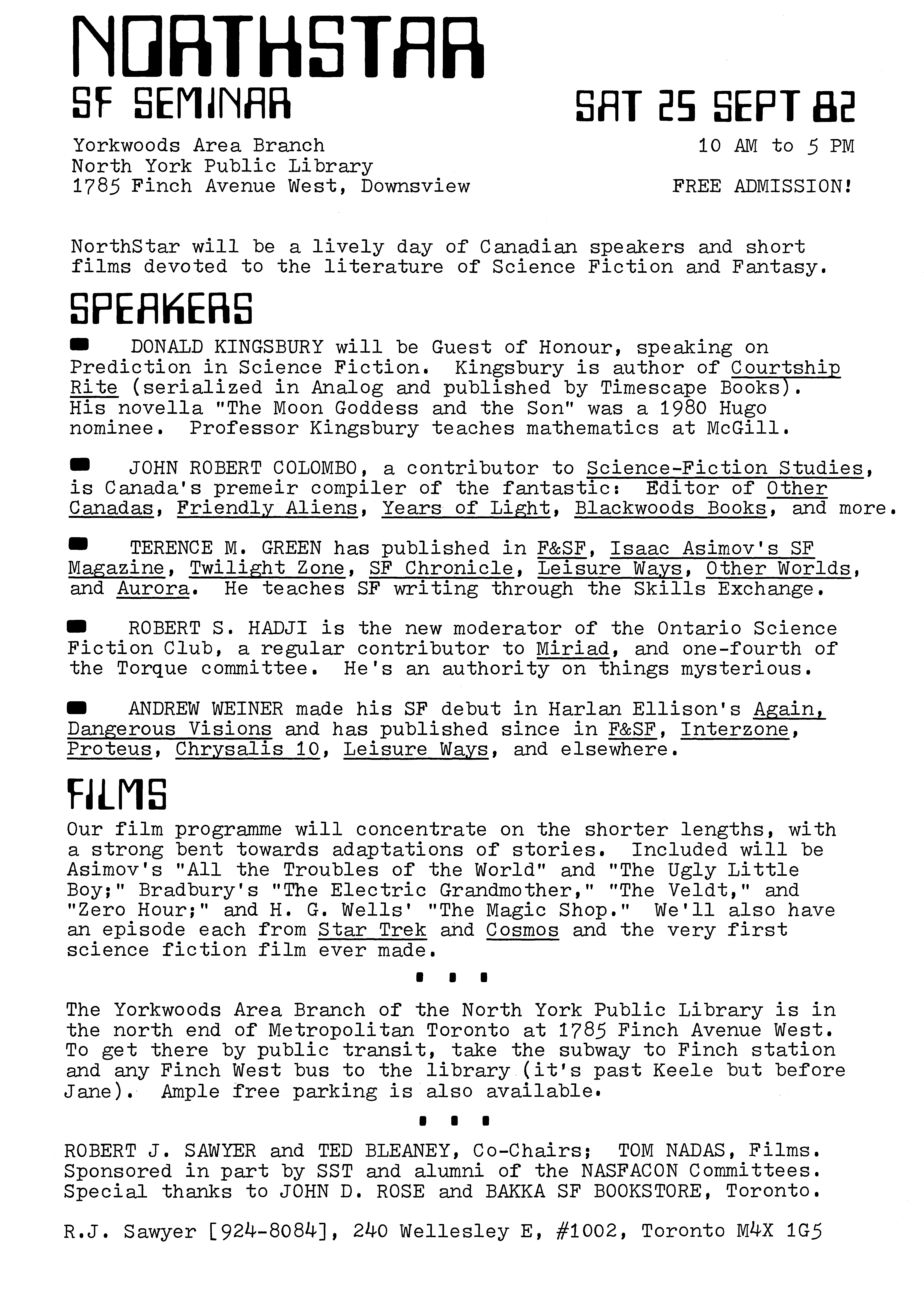
Forty years ago this month, when I was 22, my great friend Ted Bleaney and I put on NorthStar, the first-ever conference on Canadian science fiction. I’ll be in South Dakota on September 25, which is the actual 40th anniversary of this event, so I’m posting about it today.
Our Guest of Honour was Donald Kingsbury of Montreal, who had recently been nominated for a Hugo for his debut novel Courtship Rite.
Other speakers were:
John Robert Colombo the editor of the first-ever Canadian SF anthology, Other Canadas
Terence M. Green and Andrew Weiner, who, at the time, were the only Canadians publishing regularly in the major US SF magazines.
Robert Knowlton (then known as Robert S. Hadji), then and now Canada’s leading expert of horror and dark fantasy literature.
Above is the flyer for the event, made by me on the electric typewriter I’d scrimped and saved to buy, with Letraset rub-down lettering for the Moore Computer typeface. Click the image for the full-size version.
While Donald Kingsbury was staying at Carolyn and my place for the event, I interviewed him at length. Richard E. Geis published the 6,500-word interview in his magazine Science Fiction Review, Spring 1984.
The wisdom of Erle Stanley Gardner, from the Perry Mason novel The Case of the Careless Kitten, published eighty years ago in 1942. Defense attorney Perry Mason is speaking to Hamilton Burger, the district attorney:
“Because the public has sat idly by and let the organized prosecutors amend the law until the constitutional guarantees of the public were swept away. We’re living in a period of changing times. It’s quite possible that the definition of crime will be broadened to include things which we might at present list in the category of political crimes. When the ordinary citizen is dragged into court, he’ll find that the cards have been stacked against him. Ostensibly, they were stacked against the professional criminal by organized public servants, but actually they’ve been stacked against Mr. and Mrs. Ordinary Citizen, because the whole legal procedure has been completely undermined.
“It’s high time for citizens to wake up to the fact that it isn’t a question of whether a man is guilty or innocent, but whether his guilt or innocence can be proved under a procedure which leaves in the citizen the legal rights to which he is entitled under a constitutional government.
“You object to spectacular, dramatic methods of defense. You overlook the fact that for the past twenty-five years you have beguiled the public into releasing its constitutional rights so that the only effective methods of defense which are left are the spectacular and the dramatic. Now then, Mr. District Attorney, you go ahead and arrest Della Street, and we’ll thrash this thing out in a courtroom.”
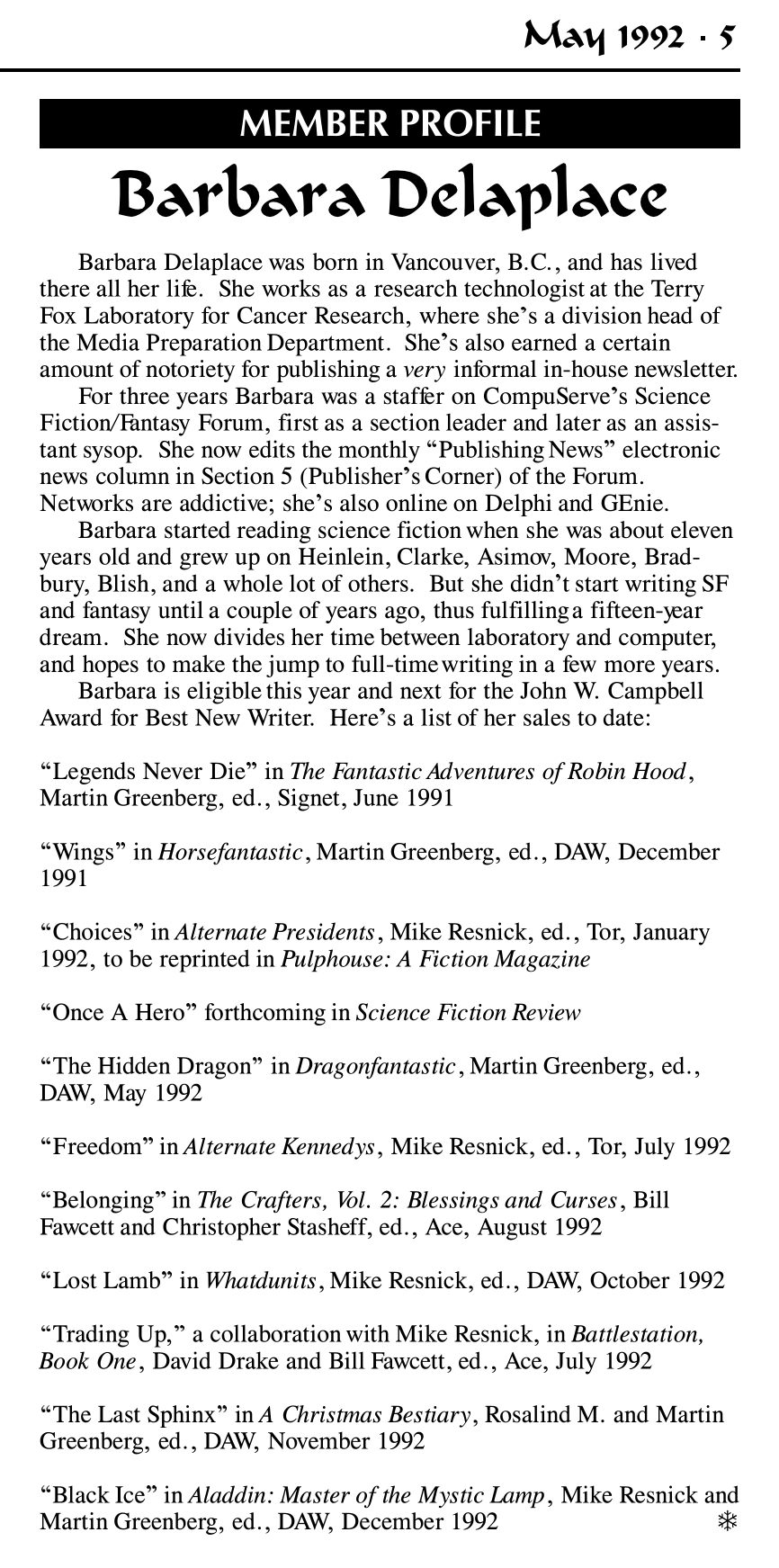
Today in Gainesville, there’s a celebration of Barbara Haldeman, sister-in-law to Joe Haldeman and the widow of Joe’s late brother, Jack.I can’t be there, but I’m thinking fondly about my friend Barbara today.
Those, like me, who used to frequent the CompuServe Science Fiction and Fantasy Forum may remember her as Barbara Delaplace, where she was an assistant sysop.She was also a fine writer and a member of SFWA. Thirty years ago, I published this profile of her in the May 1992 edition of Alouette, the newsletter I used to produce for Canadian members of SFWA.
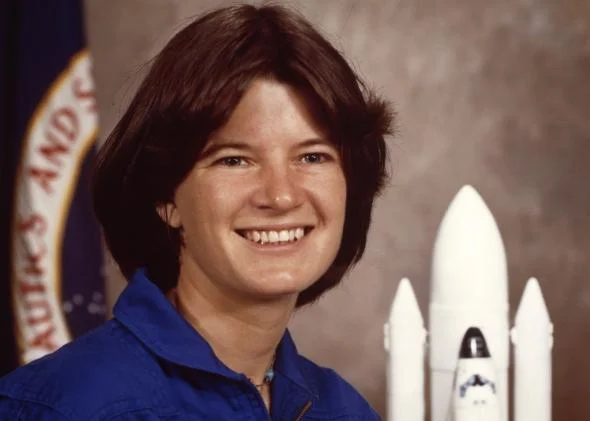
Ten years ago today: Sally Ride, the first American woman in space — an inspiration to a generation, a true patriot and hero — died. Sally Ride was a lesbian. Sally Ride’s partner of 27 years, Tam O’Shaughnessy, was ineligible for survivor benefits because Tam happens to be a woman.
Supreme Court of the United States: honor Sally’s memory. Refuse to revisit the settled law of Obergefell v. Hodges, which, in 2015, recognized same-sex marriage coast-to-coast.
I was interviewed today on the CTV Calgary Noon News about my WWW trilogy of Wake, Watch, and Wonder winning the Machine Intelligence Foundation for Rights and Ethics (MIFRE) Media Award. You can watch the six-minute sement here.
I am pleased as punch to have just won the 2021 Media Award from the Machine Intelligence Foundation for Rights and Ethics (MIFRE) for my WWW trilogy of Wake, Watch, and Wonder. The award trophy is truly gorgeous, consisting of layers of laminated wood under glass — I just love the look of it.
The award is given “for the recognition of the representation of human and Machine Intelligence forming and thriving in a cooperative peer relationship.” Works published in any year are eligible for nomination. This is the second year the award has been given; last year’s winner was the story “When Robot and Crow Saved East St. Louis” by Annalee Newitz.
In announcing this year’s win, David Miller wrote:
It is my pleasure, as president and co-founder of the Machine Intelligence Foundation for Rights and Ethics, to present you with the 2021 Media Award for your series, the WWW Trilogy. It was exactly what we had hoped to find: a story that demonstrated the positive cooperation between humans and conscious machines, for the benefit of all.
We enjoyed what was a fascinating possible origin story for Machine Intelligence, and particularly appreciated how it demonstrated that its relationship with the human race could become a mutually beneficial partnership. Our species has a discouraging record of first contact with new peoples, and stories like yours show that we can and should be better than we have in the past. Our hope is that by promoting works such as yours, we can encourage the public to welcome the idea of different kinds of “people” as friends and partners. We feel that the future depends on our ability as a civilization to be welcoming and respectful as the existence of conscious machines looms as a near certainty.
Please accept my heartiest thanks for your thoughtful and encouraging series. I hope that our recognition gives you a small fraction of the pleasure we received by reading it.
We wish you the best of luck in what is already a thriving and varied writing career, and hope that in the future, we may see another of your works nominated for the award again.
This Friday, I’ll be recording an episode as guest on the always-interesting MIFRE Podcast.
For more about the Machine Intelligence Foundation for Rights and Ethics, see here: